What you are missing is the structure the trade moved through.
Level-two depth is that structure. Where a price chart gives you a single point - the last transaction - the order book gives you a field: every limit order sitting at every level, the size behind each one, and how that weight is distributed between buyers and sellers. When size on one side of the book dwarfs the other, the book is not balanced. That imbalance is what Order Flow Intelligence reads.
What depth is and what an imbalance means
Think of the book as a ledger of intent. Bids are buyers willing to transact at a price below the market; offers are sellers willing to transact above it. The spread between them is where the last trade happened. But the book does not stop at the spread. It extends down through every resting bid and up through every resting offer, each level carrying its own volume.
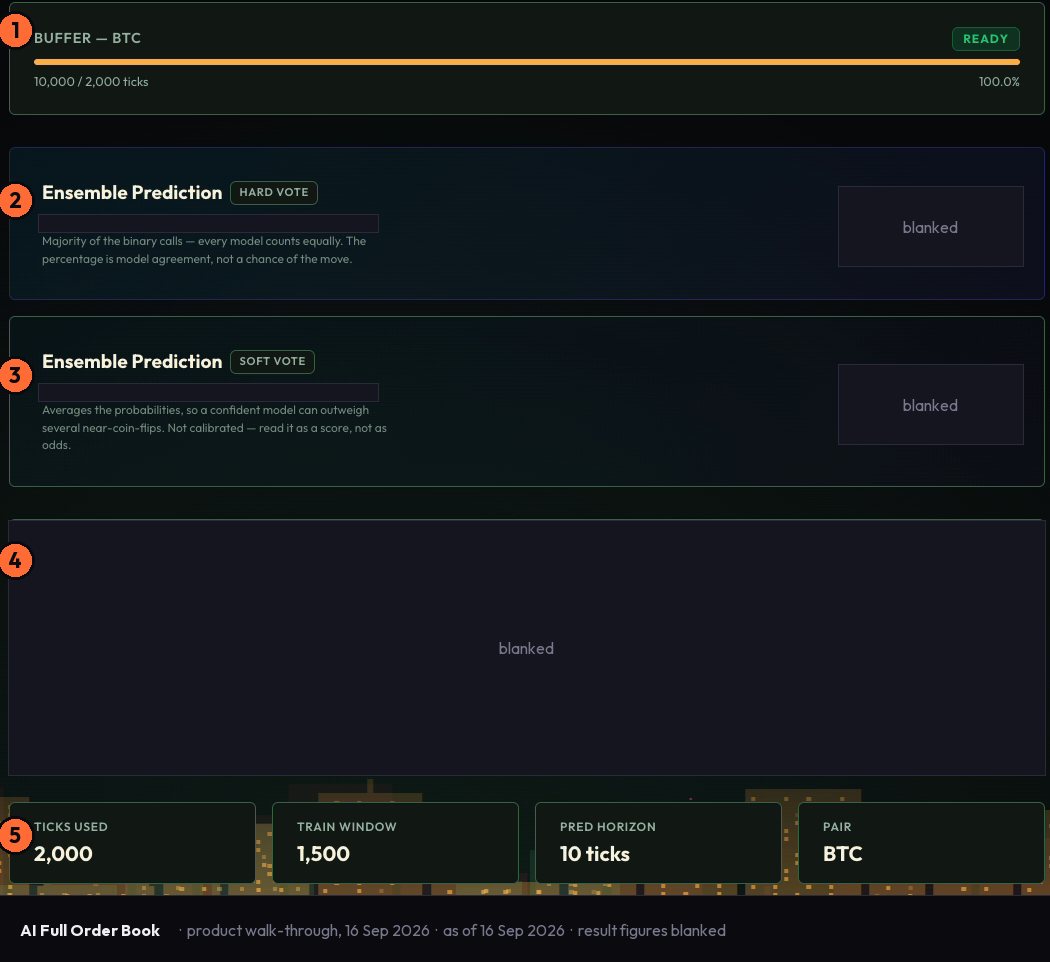
When that volume is unequal - when the bids are thick and the offers are thin, or the other way around - the book has a lean. A lean is not a guarantee of direction. It is a description of where the pressure is sitting right now. Order Flow Intelligence resolves that imbalance to a directional read, but the surface does not produce a single arrow and call it done. It produces two outputs at once: the hard vote and the soft vote.
The hard vote is the majority verdict across five classifiers - RandomForest, ExtraTrees, AdaBoost, XGBoost, and SVC. Each one looks at the recent tick buffer independently and casts its own UP or DOWN. The direction that wins the majority is the hard vote. The soft vote shows how the five are split behind it. A five-to-zero split and a three-to-two split both have the same hard vote direction, but they are not the same read.
The surface does not pick the more confident-looking number and present it as a signal. It shows you where the classifiers agree and where they do not, and leaves that picture on screen.
A worked example on a labelled synthetic series
Say you are watching BTC on Order Flow Intelligence and, as an example, the buffer has just retrained. The hard vote comes back UP. The soft vote is three out of five. On the same surface, another asset comes back UP with five out of five. Both point the same way. One of them has the entire ensemble behind it; the other has a majority with two classifiers dissenting. The surface shows both reads as UP, and it shows the split behind each one. The disagreement in the second case is not noise to be smoothed away - it is information about the state of the book at that moment.
What the read cannot tell you
The buffer trains on recent ticks and retrains when you switch instruments. What the classifiers vote on is the book as it stands in the current window. The ten-tick horizon is short by design. The surface is not a forward model of where price will be in an hour. It is a structured read on what the book is showing now, on this instrument, on this tick buffer.
When the five classifiers split three-to-two, the surface does not resolve the disagreement for you. It flags it. That is not a limitation to work around - it is the point. A surface that always produces a clean directional verdict regardless of how divided the underlying vote is would be hiding information. The split is part of the read.
The classifiers retrain per asset on demand, so switching instruments gives you a fresh read on that instrument's book rather than a static model applied everywhere. Binance full L2 depth on BTC, ETH, XRP, BNB, and SOL is the source. The tick buffer fills on screen as you watch, so you can see when the read has enough to go on.
What to do with it
Open Order Flow in the Retail view, watch the buffer fill, and read the hard vote and the soft vote side by side before the arrow.